Epoxy Flooring
Epoxy Flooring in Temple, TX
Seamless, hard-wearing epoxy floors for garages, shops, commercial spaces, and interiors, installed over properly prepared concrete.
- Locally Owned and Operated
- Insured, Certificate on Request
- Free On-Site Estimates
What an epoxy floor is
Epoxy is a two-part coating: a resin and a hardener that react to form a rigid, durable plastic. Applied over properly ground concrete, it bonds into the surface and creates a seamless layer that resists stains, chemicals, and abrasion far better than bare concrete or paint.
On its own, epoxy can be a simple, solid-color utility floor. With flake, metallic pigments, or quartz added, it becomes a decorative finish. And as a base coat, it is the foundation of most garage and commercial coating systems, usually topped with a polyaspartic or urethane layer for UV and wear resistance.
The difference between an epoxy floor that lasts and one that peels in a year almost always comes down to prep and product quality. That is where we focus.
Types of Epoxy Floors
Choosing the right epoxy
Roll-Applied High-Build
Thick coats rolled and squeegeed over the floor. The standard for garages, shops, and warehouses.
Self-Leveling
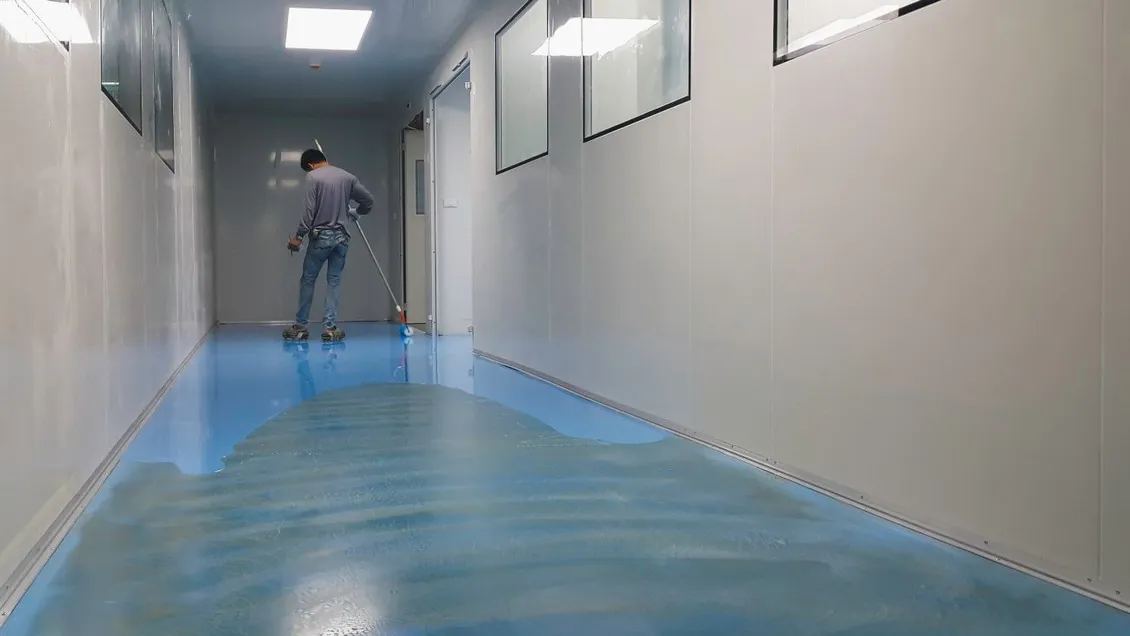
Poured and spread to a smooth, flat, glass-like surface. Common in commercial, clean-room, and showroom spaces.
Flake and Quartz Broadcast
Chips or colored quartz sand broadcast into wet epoxy for texture, grip, and a forgiving look.
Metallic
Pearlescent pigments worked through the epoxy by hand for depth, movement, and a high-gloss finish.
Epoxy vs. Polyaspartic
Two coatings, different strengths
We use both, often in the same floor. Here is how they compare.
| Property | Epoxy | Polyaspartic |
|---|---|---|
| Bond to concrete | Excellent on ground concrete | Very good |
| Film build | Thick, fills minor imperfections | Thinner per coat |
| UV stability | Yellows in sunlight | Stays clear |
| Cure speed | Slower | Fast |
| Typical role | Base coat, solid floors, metallics | Topcoat, outdoor and sunny areas |
Where Epoxy Works
Spaces we coat with epoxy
Epoxy suits almost any interior concrete floor that needs to be tougher, brighter, and easier to clean. In homes, that means garages, workshops, laundry rooms, and the occasional finished-concrete living space. In businesses, it covers everything from warehouse aisles and service bays to clinic hallways and retail floors.
Where a floor gets direct sun, we pair epoxy with a UV-stable topcoat. Where it gets hot washdowns, like a commercial kitchen, we may recommend urethane cement instead. And for outdoor slabs, we move to polyaspartic or polyurea systems built for sunlight.
For residential garages specifically, see garage floor coating. For warehouses, shops, and other businesses, see commercial and industrial flooring.
Free On-Site Estimate
Talk to us about an epoxy floor
Tell us about the space and how it gets used. We'll check the concrete in person and recommend a system that fits.
Or call (254) 500-2099.
Get a Free Estimate
Tell us about your floor and we'll set up a time to measure and talk through options.
Common Questions
How long does an epoxy floor last?
It depends on prep, product quality, coating thickness, and traffic. A properly installed epoxy floor on well-prepared concrete can last many years in a home garage, while a heavy industrial floor may need a fresh topcoat sooner. The biggest factor is prep, which is why we grind every floor.
Why does epoxy turn yellow?
Most epoxies amber, or yellow, when exposed to UV light over time. It is a chemistry issue, not a defect. Where a floor gets sunlight, like a garage with the door open or a room with big windows, we put a UV-stable polyaspartic or urethane topcoat over the epoxy.
Can epoxy go outside?
Plain epoxy is not a good choice outdoors because sunlight breaks it down and yellows it. For porches, patios, and pool decks, polyaspartic and polyurea coatings are the better fit. See our concrete floor coating page for outdoor options.
What is 100% solids epoxy?
It is epoxy with no water or solvent to evaporate, so what goes on the floor is what stays on the floor. It builds a thicker, harder film than water-based products. Most professional systems use high-solids epoxy for the base coat.
Does epoxy work on a concrete floor with moisture?
Standard epoxy can blister and peel if moisture vapor pushes up through the slab. We test before we coat, and if readings are high we use a moisture-mitigating epoxy primer designed for those conditions.
Ready to talk about your floor?
Call or send a few details, and we'll set up a free on-site estimate.