Garage Floors
Garage Floor Coating in Temple, TX
Turn a stained, dusty slab into a clean, bright floor that handles hot tires, road grime, and the Central Texas heat.
- Locally Owned and Operated
- Insured, Certificate on Request
- Free On-Site Estimates
Why Temple garages are hard on floors
A garage floor in Bell County takes a beating. Summer heat builds up behind a closed door, tires come in hot off the highway, and the clay soils under many neighborhoods expand and shrink with wet and dry spells, which cracks slabs over time. Add oil drips, fertilizer, and the occasional dropped wrench, and bare concrete never looks clean for long.
A professionally installed coating seals the slab, resists stains, and turns the garage into a space you can actually use, whether that is a workshop, a home gym, or just a place to park without tracking dust into the house.
Many homes in Temple's newer subdivisions come with plain broom-finished garage floors, and older homes closer to downtown often have decades of stains and patchwork. Both are good candidates for coating once the concrete is ground and repaired.
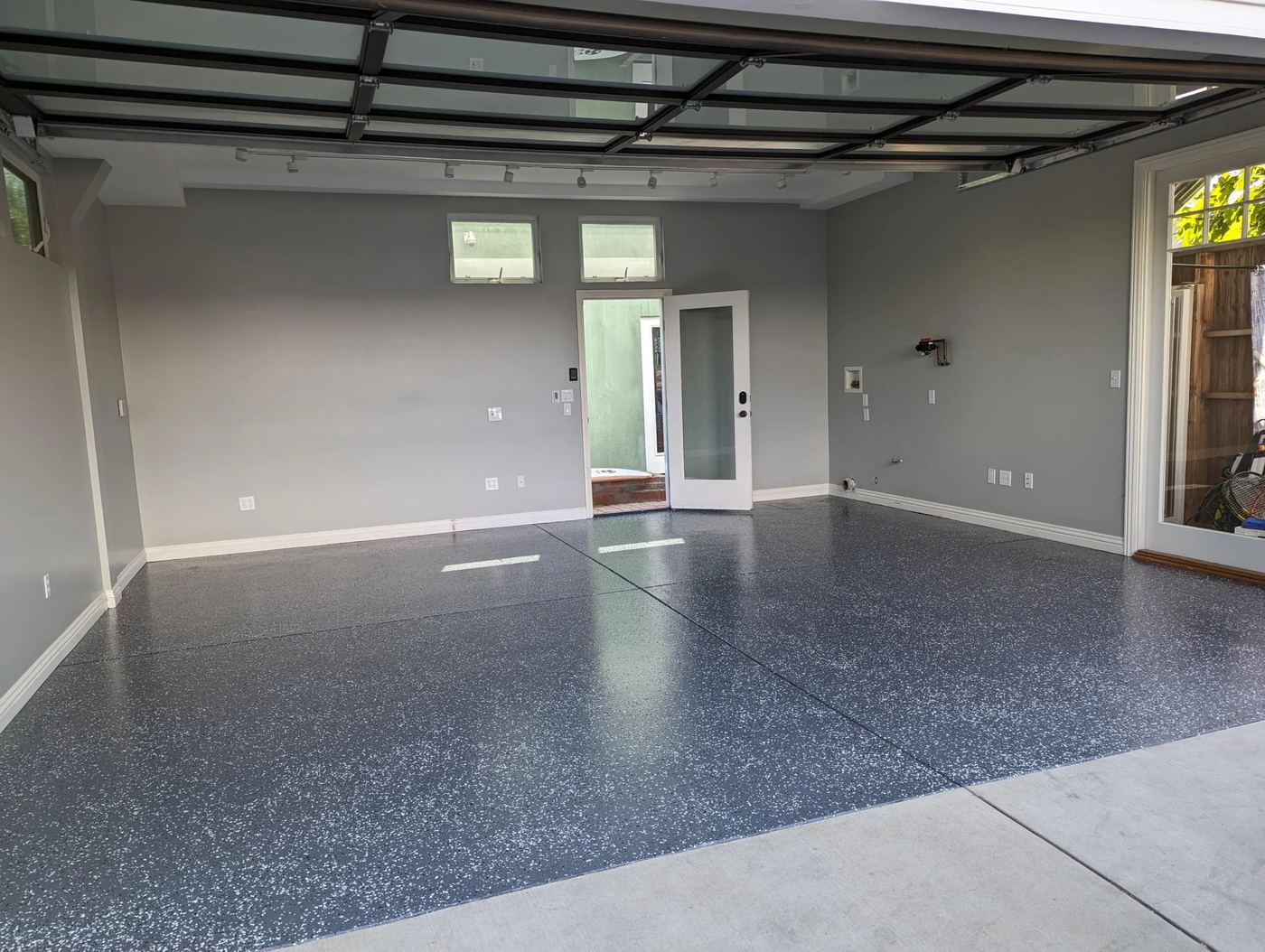
Our Garage System
Built in layers, starting with the concrete
- Diamond grinding. Opens the surface so the base coat can bond into the concrete, and removes sealers and residue.
- Crack and pit repair. Cracks, spalls, and pitting are filled and ground flush.
- Epoxy base coat. A pigmented base that soaks into the profiled slab and locks in the flake.
- Full flake broadcast. Vinyl color chips are broadcast to refusal, then the excess is scraped and vacuumed.
- Polyaspartic topcoat. A clear, UV-stable topcoat that resists hot tires, chemicals, and yellowing in sunlight.
Want a different look? Metallic and solid-color finishes work in garages too. We'll talk through the trade-offs at the estimate.
Compare
Professional coating vs. a DIY kit
Hardware-store kits are tempting, but many failed garage coatings start with one.
| Step | Typical DIY kit | Professional system |
|---|---|---|
| Surface prep | Acid etch or degreaser | Diamond grinding to open the concrete |
| Crack repair | Usually skipped | Filled and ground flush |
| Coating thickness | One thin coat | Multiple coats, built to spec |
| Topcoat | Often none, or water-based | UV-stable polyaspartic |
| Hot-tire resistance | Prone to lifting | Designed to resist it |
Pricing
What a garage floor costs
The size of the garage matters, but so does what is going on with the slab. Grinding off an old peeling coating, repairing a long settlement crack, or treating a moisture problem all add to the job. A clean, sound slab costs less to coat than one that needs work first.
National estimate, not a quote: cost guides commonly list installed epoxy and polyaspartic garage coatings at about $3 to $12 per square foot. A two-car garage is usually 400 to 600 square feet. We give you an exact, itemized price after measuring.
Good Fit For
Beyond parking
- Home workshops and hobby spaces
- Home gyms
- Laundry rooms and mudrooms off the garage
- Golf cart, boat, and RV storage
- Detached shops and casitas
Free On-Site Estimate
Get a price on your garage
Send a few details and we'll set up a time to measure the garage, check the concrete, and bring finish samples. There's no cost and no obligation.
Or call (254) 500-2099.
Get a Free Estimate
Tell us about your floor and we'll set up a time to measure and talk through options.
Common Questions
How much does it cost to coat a two-car garage?
A typical two-car garage runs roughly 400 to 600 square feet. National cost guides commonly list professionally installed epoxy and polyaspartic coatings at about $3 to $12 per square foot, which is a national estimate, not a quote. Cracks, old coatings, and moisture all affect the final number, so we price every garage from an on-site measurement.
Will hot tires peel the coating?
Hot-tire pickup happens when a thin or poorly bonded coating softens under a hot tire and lifts. A diamond-ground slab, a proper epoxy base, and a polyaspartic topcoat are built to resist it. That combination is a big part of why we do not recommend single-coat kits for Texas garages.
Is a coated garage floor slippery?
A flake floor has a slight texture that gives decent grip, even when it is damp. If you want more traction, we can add a fine anti-slip additive to the topcoat. Smooth solid and metallic finishes are slicker when wet, which is one reason flake is the most common garage choice.
My house is brand new. When can the garage be coated?
New concrete needs time to cure and release moisture before it is coated. Builders often reference a 28-day minimum, and we still test moisture before coating any new slab. If you are in a new subdivision, it is worth getting an estimate early so you can plan around move-in.
How do I clean and care for a coated garage floor?
Sweep or dust-mop grit regularly, and clean with a mop or soft deck brush and a mild, pH-neutral cleaner. Wipe up oil and chemical spills when you see them. Avoid harsh acids and citrus cleaners. Felt pads under heavy toolboxes and stands help prevent gouges.
Ready for a better garage floor?
Call or request an estimate, and we'll come measure and bring samples.